
济南源茂瑞鑫智能科技有限公司
电话: +8613290332270 江先生: +8613290332270 E-mail: yuanmaowaimao@duwoft.cn
NEWS
新闻中心
铝板分类
- 分类:公司新闻
- 作者:超级管理员
- 来源:本站
- 发布时间:2025-10-21 14:52:52
- 访问量:12
【概要描述】第三部分铝板分类 Part 3: Classification of Aluminum1.按合金成分分为Classified by Alloy Composition:高纯铝板:含量99.9以上高纯铝轧制而成High-Purity Aluminum Plate:Rolled
铝板分类
【概要描述】第三部分铝板分类 Part 3: Classification of Aluminum1.按合金成分分为Classified by Alloy Composition:高纯铝板:含量99.9以上高纯铝轧制而成High-Purity Aluminum Plate:Rolled
- 分类:公司新闻
- 作者:超级管理员
- 来源:本站
- 发布时间:2025-10-21 14:52:52
- 访问量:12
第三部分铝板分类
Part 3: Classification of Aluminum
1. 按合金成分分为 Classified by Alloy Composition:
高纯铝板: 含量99.9以上高纯铝轧制而成
High-Purity Aluminum Plate: Rolled from high-purity aluminum with a purity content of over 99.9%.
纯铝板 :成分基本由纯铝轧制而成,铝含量99以上。
Pure Aluminum Plate: Basically rolled from pure aluminum, with an aluminum content of over 99%.
合金铝板 :由铝及辅助合金组成,通常有铝铜,铝锰,铝硅,铝镁,等系列
Alloy Aluminum Plate:Composed of aluminum and auxiliary alloys, and usually categorized into series such as aluminum-copper, aluminum-manganese, aluminum-silicon, aluminum-magnesium, etc.
复合铝板或者釺焊板:通过多种材料复合的手段得到特殊用途铝板材料
Composite Aluminum Plate or Brazing Plate: A type of aluminum plate material with special uses, obtained through composite processes involving multiple materials.
包铝铝板 :铝板外边包覆薄铝板用于特殊用途
Clad Aluminum Plate: An aluminum plate with a thin aluminum layer clad on its outer surface, used for special purposes.
2. 按厚度分为:(单位mm) Classified by Thickness: (Unit: mm)
薄板Thin Sheet(aluminum sheet) 0.15-2.0 常规板Regular Plate(aluminum sheet) 2.0-6.0
中板Medium Plate(aluminum plate) 6.0-25.0 厚板Thick Plate(aluminum plate) 25-200
3:按产品形状分类。
按形状主要可分为板材、带材、条材、箔材、管材、棒材、型材、线材、粉材、锻件和模锻件、冷压件等。
Classification by Product Shape
Mainly divided into plates, strips, bars, foils, tubes, rods, profiles, wires, powders, forgings and die forgings, cold-pressed parts, etc., by shape.
4:按断面积或质量大小分类。
按断面积或质量大小,可分为特大型、大型、中型、小型和特小型等几个类别。
如投影面积大于 2m的模锻件,断面积大于400cm的型材,质量大于10kg的压铸件等,都属于特大型产品;而断面积小于0.1cm的型材,质量小于0.1kg的压铸件等都称为特小型产品。
Classification by Cross-Sectional Area or Mass
Based on cross-sectional area or mass, products can be divided into several categories: extra-large, large, medium, small, and extra-small.
For example, die forgings with a projected area larger than 2 m², profiles with a cross-sectional area larger than 400 cm², and die castings with a mass larger than 10 kg all fall into the extra-large product category; while profiles with a cross-sectional area smaller than 0.1 cm² and die castings with a mass smaller than 0.1 kg are referred to as extra-small products.
5:按产品的外型轮廓尺寸分类。
按外形轮廓尺寸、外径或外接圆直径的大小,可分为特大型、大型、中小型和超小型几个类别。
如宽度大于 250mm、长度大于10m的型材为大型型材,宽度大于800mm的型材为特大型型材,而宽度小于10mm的型材为超小型精密型材等。
Classification by Product's Overall Contour Dimension
Based on the size of overall contour dimension, outer diameter, or circumscribed circle diameter, products can be divided into several categories: extra-large, large, medium-small, and ultra-small.
For example, profiles with a width of more than 250 mm and a length of more than 10 m are classified as large profiles; profiles with a width of more than 800 mm are extra-large profiles; while profiles with a width of less than 10 mm are referred to as ultra-small precision profiles, and so on.
6:按产品壁厚分类。
按产品壁厚可分为超厚、厚、薄、特薄等几个类别。
Classification by Product Wall Thickness
Based on the product wall thickness, products can be divided into several categories: extra-thick, thick, thin, and ultra-thin.
7:主要成形方法有:铸造成形法、塑性成形法和深加工法。
Main Forming Methods:
Casting forming method, plastic forming method, and deep processing method.
铸造成形法:
就是利用铸造铝合金的良好流动性和可填充性,在一定温度、速度和外力条件下,将铝合金熔体浇注到各种模型中,以获得具有所需形状与组织性能的铝合金铸件和压铸件的方法。
Casting Forming Method:
It is a method that utilizes the good fluidity and fillability of cast aluminum alloys. Under certain conditions of temperature, speed, and external force, the aluminum alloy melt is poured into various molds to obtain aluminum alloy castings and die castings with the required shape, structure, and performance.
塑性成形法:
是利用铝及铝合金的良好塑性,在一定的温度、速度条件下,施加各种形式外力,克服金属对于变形的抵抗,使其产生塑性变形,从而得到各种开关、规格尺寸和组织性能和铝及铝合金板、带、条、箔、管、棒、型、线和锻件等的加工方法。
Plastic Forming Method:
It is a processing method that utilizes the good plasticity of aluminum and aluminum alloys. Under certain temperature and speed conditions, various forms of external force are applied to overcome the metal's resistance to deformation, causing it to undergo plastic deformation. Through this process, aluminum and aluminum alloy products such as plates, strips, bars, foils, tubes, rods, profiles, wires, and forgings—with desired shapes, specifications, dimensions, and structural properties—are obtained.
深加工:
是将铸造法或塑性成形法所获得的半成品进一步通过表面处理或表面改性、机械加工或电加工、焊接或其他接合、剪断、冲切、拉伸、弯曲等方法,加工成成品零件或部件的方法。
Deep Processing:
It is a method that further processes the semi-finished products obtained by casting or plastic forming into finished parts or components through methods such as surface treatment or surface modification, mechanical processing or electrical discharge machining, welding or other joining processes, cutting, blanking, stretching, and bending.
按变形过程中的受力和变形方式分:
按工件在变形过程中的受力与变形方式(应力 -应变状态),铝及铝合金加工可分为
轧制、挤压、拉拔、锻造、旋压、成形加工(如冷冲压、冷变、深冲等)及深度加工等。
Classification by Force and Deformation Mode During the Deformation Process
Based on the force applied to the workpiece and the deformation mode (stress-strain state) during the deformation process, the processing of aluminum and aluminum alloys can be divided into rolling, extrusion, drawing, forging, spinning, forming processes (such as cold stamping, cold forming, deep drawing, etc.), and deep processing.
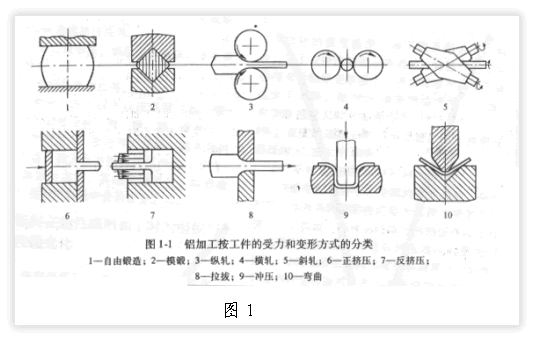
(1)轧制 Rolling
轧制是锭坯依靠摩擦力被拉进旋转的轧辊间,借助于轧辊施加的压力,使其横断面减小,形状改变,厚度变薄而长度增加的一种塑性变形过程。根据轧辊旋转方向不同,轧制又可分为纵轧、横轧和斜轧。纵轧时,工作轧辊的转动方向相反,轧件的纵轴线与轧辊的轴线相互垂直,它是铝合金板、带、箔材平辊轧制中最常见的方法;横轧时,工作轧辊的转动方向相同,轧件的纵轴线与轧辊轴线相互平行,在铝合金板带材轧制中很少使用;斜轧时,工作轧辊的转动方向相同,轧件的纵轴线与轧辊轴线成一定的倾斜角度。在生产铝合金管材和某此异形产品时常用双辊或多辊斜轧。根据辊系不同,铝合金轧制可分为两辊(一对)系轧制,多辊系轧制和特殊辊系(如行星式轧制、 V形轧制等)轧制。根据轧辊形状不同,铝合金轧制可分为平辊轧制和孔型辊轧制等。根据产品品种不同,铝合金轧制又可分为板、带、箔材轧制,棒材、扁条和异形型材轧制,管材和空心型材轧制等。
Rolling is a plastic deformation process in which an ingot or billet is drawn into the space between rotating rolls by means of friction. Under the pressure applied by the rolls, the cross-section of the billet is reduced, its shape is changed, its thickness is decreased, and its length is increased.
According to the different rotation directions of the rolls, rolling can be divided into longitudinal rolling, transverse rolling, and skew rolling:
In longitudinal rolling, the working rolls rotate in opposite directions, and the longitudinal axis of the rolled piece is perpendicular to the axis of the rolls. This is the most common method in the flat-roll rolling of aluminum alloy plates, strips, and foils.
In transverse rolling, the working rolls rotate in the same direction, and the longitudinal axis of the rolled piece is parallel to the axis of the rolls. This method is rarely used in the rolling of aluminum alloy plates and strips.
In skew rolling, the working rolls rotate in the same direction, and the longitudinal axis of the rolled piece forms a certain inclined angle with the axis of the rolls. Double-roll or multi-roll skew rolling is often used in the production of aluminum alloy tubes and some special-shaped products.
According to the different roll systems, aluminum alloy rolling can be classified into two-roll (one pair) rolling, multi-roll rolling, and special roll system rolling (such as planetary rolling, V-type rolling, etc.).
According to the different shapes of the rolls, aluminum alloy rolling can be divided into flat-roll rolling, grooved-roll rolling, and so on.
According to the different types of products, aluminum alloy rolling can also be categorized into the rolling of plates, strips, and foils; the rolling of rods, flat bars, and special-shaped profiles; and the rolling of tubes and hollow profiles.
(2)挤压 Extrusion
挤压是将锭坯装入挤压筒中,通过挤压轴对金属施加压力,使其从给定形状和尺寸的模孔中挤压,产生塑性变形而获得所要求的挤压产品的一种加工方法。按挤压时金属流动方向不同,挤压又可分为正向挤压、反向挤压和联合挤压。正向挤压时,挤压轴的运动方向和挤出金属的流动方向一致,而反向挤压时节,挤压轴的运动方向与挤出金属的流动方向相反。按锭坯的加热温度,挤压可分为热挤压和冷挤压。热挤压是将锭坯加热到再结晶温度以上进行挤压,冷挤压是在室温下进行挤压。
Extrusion is a processing method where an ingot or billet is loaded into an extrusion container. Pressure is applied to the metal via an extrusion stem, forcing it to be extruded through a die orifice of a given shape and size. The metal undergoes plastic deformation, resulting in the desired extruded product.
According to the different flow directions of the metal during extrusion, extrusion can be divided into direct extrusion, indirect extrusion, and combined extrusion. In direct extrusion, the movement direction of the extrusion stem is consistent with the flow direction of the extruded metal. In indirect extrusion, however, the movement direction of the extrusion stem is opposite to the flow direction of the extruded metal.
Based on the heating temperature of the ingot or billet, extrusion can be classified into hot extrusion and cold extrusion. Hot extrusion involves heating the ingot or billet to a temperature above its recrystallization point before extrusion, while cold extrusion is performed at room temperature.
(3)拉拔 Drawing
拉拔是拉伸机(或拉拔机)通过夹钳把铝及铝合金坯料(线士或管坯)从给定形状和尺寸的模孔中拉出来,使其产生塑性变形而获得所需的管、棒、型、线材的加工方法。根据所生产的产品品种和形状不同,拉伸可分为线材拉伸、管材拉伸、棒材拉伸和型材拉伸。管材拉伸又可分为空拉、带芯头拉伸和流动芯头拉伸。拉伸加工的主要要素是拉伸机、拉伸模和拉伸卷筒。根据拉伸配模,拉伸可分为单模拉伸和多模拉伸。
Drawing is a processing method in which a drawing machine (or stretcher) uses a clamp to pull aluminum and aluminum alloy billets (wire billets or tube billets) through a die orifice of a specified shape and size. This causes the billets to undergo plastic deformation, thereby producing the required tubes, rods, profiles, and wires.
According to the different types and shapes of products being manufactured, drawing can be divided into wire drawing, tube drawing, rod drawing, and profile drawing. Among these, tube drawing can be further categorized into hollow drawing (sinking), mandrel drawing, and floating mandrel drawing.
The main elements of the drawing process are the drawing machine, drawing die, and drawing reel. Based on the die configuration used in drawing, it can be classified into single-die drawing and multi-die drawing.
(4)锻造 Forging
锻造是锻锤或压力机(机械的或液压的)通过锤头或压头对铝及铝合金铸锭或锻坯施加压力,使金属产生塑性变形的加工方法。铝合金锻造有自由锻和模锻两种基本方法。自由锻是将工件放在平砧(或型砧)间进行锻造;模锻是将工件放在给定尺寸和形状的模具内,然后对工件施加压力进行锻造变形,而获得所要求的模锻件。
Forging is a processing method in which a forging hammer or a press (mechanical or hydraulic) applies pressure to aluminum and aluminum alloy ingots or forging billets through a hammer head or a pressure head, causing the metal to undergo plastic deformation.
There are two basic methods for aluminum alloy forging: open-die forging and closed-die forging.
Open-die forging involves forging the workpiece between flat dies (or shaped dies).
Closed-die forging (die forging) entails placing the workpiece into a die with a specified size and shape, then applying pressure to the workpiece to induce forging deformation, thereby obtaining the required die forgings.
铝及铝合金加工材中以压延材(板、带、条、箔材)和挤压材(管、棒、型、线材)应用最广,产量最大,据近年的统计,这两类材料的年产量分别占世界铝材总年产量(平均)的 58%和39%左右,其余铝加工材,如锻造产品等,仅占铝材总产量的百分 之几。
Among aluminum and aluminum alloy processed materials, rolled products (plates, strips, bars, foils) and extruded products (tubes, rods, profiles, wires) have the widest applications and the largest output. According to recent statistics, the annual output of these two types of materials accounts for approximately 58% and 39% respectively of the world's total annual aluminum output (on average). The remaining aluminum processed materials, such as forged products, account for only a few percentage points of the total aluminum output.
8:按合金热处理特点分为不可热处理强化铝合金和可热处理强货铝合金两大类。
Based on the characteristics of alloy heat treatment, aluminum alloys are divided into two major categories: non-heat-treatable strengthened aluminum alloys and heat-treatable strengthened aluminum alloys.
不可热处理强化铝合金有:纯铝、AL-Mn(3系)、AL-Mg(5系)、AL-Si(4系)系合金等。
Non-heat-treatable strengthened aluminum alloys include: pure aluminum, Al-Mn (3xxx series), Al-Mg (5xxx series), Al-Si (4xxx series) alloys, etc.
可热处理强化铝合金:AL-Mg-Si(6系)、Al-Cu(2系)、Al-Zn-Mg(7系)系合金等。
Heat-treatable strengthened aluminum alloys include: Al-Mg-Si (6xxx series), Al-Cu (2xxx series), Al-Zn-Mg (7xxx series) alloys, etc.
9:按合金中所含主要元素成分可分为:
Based on the main elemental components contained in the alloy, (aluminum alloys) can be classified into:
①1系工业纯铝 1xxx Series Commercial Pure Aluminum
②2系铝铜合金Al-Cu 2xxx Series Aluminum-Copper Alloy (Al-Cu)
③3系铝锰合金Al-Mn 3xxx Series Aluminum-Manganese Alloy (Al-Mn)
④4系铝硅合金Al-Si 4xxx Series Aluminum-Silicon Alloy (Al-Si)
⑤5系铝镁合金Al-Mg 5xxx Series Aluminum-Magnesium Alloy (Al-Mg)
⑥6系铝镁硅合金Al-Mg-Si 6xxx Series Aluminum-Magnesium-Silicon Alloy (Al-Mg-Si)
⑦7系铝锌镁合金Al-Zn-Mg 7xxx Series Aluminum-Zinc-Magnesium Alloy (Al-Zn-Mg)
⑧8系铝锂合金Al-Li 8xxx Series Aluminum-Lithium Alloy (Al-Li)
⑨9系备用合金 9xxx Series Reserved Alloys
10:根据加工工艺不同又可分为铸轧和热轧。
It can be further divided into cast rolling and hot rolling according to different processing technologies.
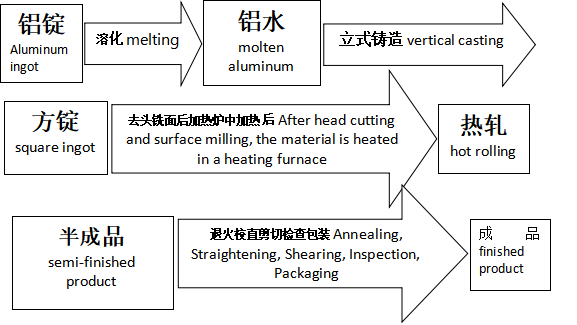
(1)热轧铝板生产工艺及流程:
铝锭---加热融化---铝水---立式铸造成坯料---去头—铣面---加热---经热轧机热轧---半成品---退火---校直---剪切----检查---包装---成品
Production Process and Flow of Hot-Rolled Aluminum Plates:
Aluminum ingot → Heating and melting → Molten aluminum → Vertical casting into billets → Head cutting → Surface milling → Heating → Hot rolling by hot rolling mill → Semi-finished product → Annealing → Straightening → Shearing → Inspection → Packaging → Finished product
铝板分类-15
热轧铝板生产工艺及流程 Production Process and Flow of Hot-Rolled Aluminum Plates:
一般厚度大于10毫米以上的是热轧铝板。
低于10毫米可以做冷轧也可以做热轧的。
热轧的特点:用于深冲,氧化,表面质量
Generally, hot-rolled aluminum plates refer to those with a thickness of more than 10 millimeters.
For aluminum plates with a thickness of less than 10 millimeters, either cold rolling or hot rolling can be used in their production.
Characteristics of hot-rolled aluminum plates: Suitable for deep drawing and oxidation processes, with specific surface quality properties.
铝板分类-16
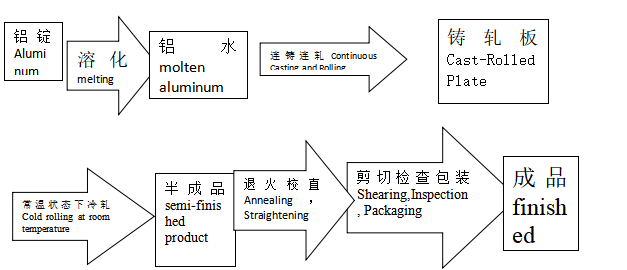
• 冷轧铝板生产工艺及流程 Production Process and Flow of Cold-Rolled Aluminum Plates:


Copyright © 2025 Jinan Yuanmao Ruixin Intelligent Technology Co., Ltd All Rights Reserved. .
